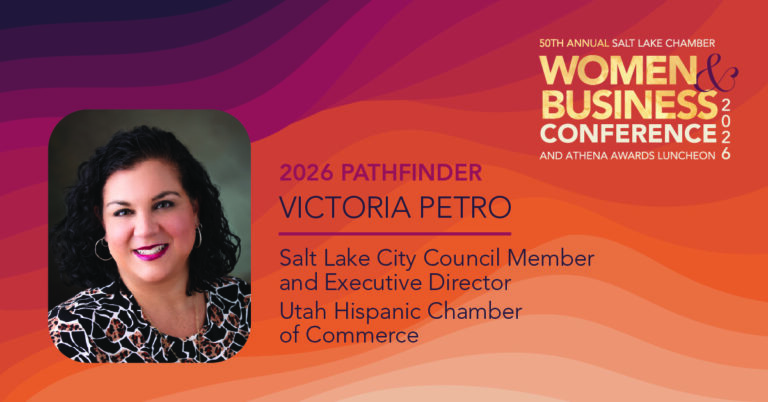
On November 11, the Salt Lake Chamber will honor seven outstanding businesswomen at the 50th annual Women & Business Conference & ATHENA Awards Luncheon. Among this year’s honorees is Victoria Petro, Salt Lake City Council member and executive director of the Utah Hispanic Chamber of Commerce and a 2026 Pathfinder Award honoree. Learn more about Petro and her career below:
Before entering elected office, what did you learn about leadership through your work in music and nonprofits?
Music impacted me most. In sports, where many of my peers refined their skills, in order for someone to win, another person must lose. Music, however, breaks that paradigm down. In order for someone to “win” in music, each member of the symphony must show up having pursued their individual best.
The oboe will never sound like the trumpet, which will never sound like the timpani, which will never sound like the violin. Some may rest while others play. But, the pursuit of personal excellence and skill — when brought together under a conductor who has a clear, positive vision of what the ensemble is aiming for — allows those musicians to create something greater than they can individually.
In order to “win” in music, each contributor must be given space and direction for their part to come to life. I view my public service through this lens. We are creating a social symphony. I am confident in my contribution and I hope to help others bring their unique contributions to our symphonic community.
How do you make sure people who aren’t always at the table have their voices heard?
I live by the acknowledgement that no one needs us to save them. Instead, we need to move alongside historically marginalized groups with an eye toward strategy and impact to ameliorate deficits we’ve inherited.
Thus, I make sure people who aren’t always at the table are heard by being intentional about how I spend my time. I make sure I have dinner regularly with people from different cultures, backgrounds, socioeconomic experiences and hobby sets.
By diversifying my social engagements and centering them around an equalizer like sharing a meal, I am in a position to easily learn what the actual needs are and to be able to “pass the mic” to them when the opportunities arise.
How do you build trust with people who may not agree with you?
Building trust is one of the most basic human functions. My approach to building it at this point is to resist the temptation of living in outrage or fawning — the two extremes that our polarized moment in time seem to incentivize most strongly. Instead, I aim to see people with whom I am relationship building through a more universal lens. Surely they love someone (a child, parent, etc.) and are loved in return. They have a favorite food. They loathe the traffic on I-15 caused by drivers who refuse to relinquish the left-hand lane. They worry about the implications of a strong Great Salt Lake and imagine the grandeur of a thriving Utah that has been well protected and shepherded.
I look for that small buy-in and engage at that point. I force myself to see their humanity and honor it and work to humble myself to listen, even when an algorithm might have me swiping in anger. Tolerating this distress is the only way I’ve found to keep my own head and heart aligned to my true north during such contentious seasons. That I’ve been able to be effective in unlikely settings as a result is a bonus!
What experiences in your life most shaped the leader you are today?
I am the granddaughter of immigrants who were ferociously proud to be given the chance to pursue their American Dream. They proudly staked their claims on suburban plots in the shadow of New York City and raised me to be the realization of their sacrifices, with food, tradition and cultural practices that anchored me to the truth that our story is a newer chapter of this American Dream.
It is those people, traditions and norms that made me the leader I am today. They taught me to nurture and create a welcoming table capable of feeding many. I do that metaphorically and literally in my life as leader and neighbor.
They taught me to understand that this system was not made for us but is capable of affording us unparalleled opportunity if we show up, work hard and stand up more times than we’re knocked down. My tenacity as a leader comes from this idea.
They taught me that the most valuable thing I carry is my name. This truth gives me an ethical anchoring and a long view for every decision I make. They taught me I come from someplace that sacrificed mightily for me to have what I do. I am the first to go to college and the first to achieve elected office.
While it would be romantic to think I picked myself up by my own bootstraps, the truth is I stand on the shoulders of family members, especially my own father, Robert Petro, who happily pushed me a step further than they themselves went.
This truth drives me to be a leader to make sure the path I leave behind me is well worn for those who come next, so they might be able to go further than I have.
Before you ever held elected office, you spent years working to strengthen your community. What drew you to that kind of work?
I was raised by a family rooted deeply in faith. During my most formative years, we were stationed overseas in Germany and Italy, as my father was a Department of Defense civilian who served with the Army. Both of these experiences put me in close proximity to adults who regularly served their communities as part of their daily lives.
When my family took me to Dachau as a 9-year-old, I saw the horrible realities that are possible when we become fractured and tribal, deepening my resolve to be a community builder to avoid such terrors. This priority continued with me until the moment I became a mother.
Once given the responsibility of caring for the precious child entrusted to me with a supernatural love, I realized there was nothing I could do for my children — no inheritance, no amount of money, no firearm, no education — that would protect them from future harm as well as minimizing the desperation experienced by those around them. Desperate people are more likely to do erratic, dangerous things.
Therefore, it is important to me that people have an education so they don’t feel trapped by their current circumstances; that they have food and clean water so they can become the best version of themselves; and that they have a predictable, rule-of-law-oriented society so they know they can make their voices heard and effect necessary change.
Building community is a matter of personal and communal benefit to me and will likely be a hallmark of my service moving forward.
Learn more and register for the 50th Women & Business Conference and ATHENA Awards Luncheon here.